

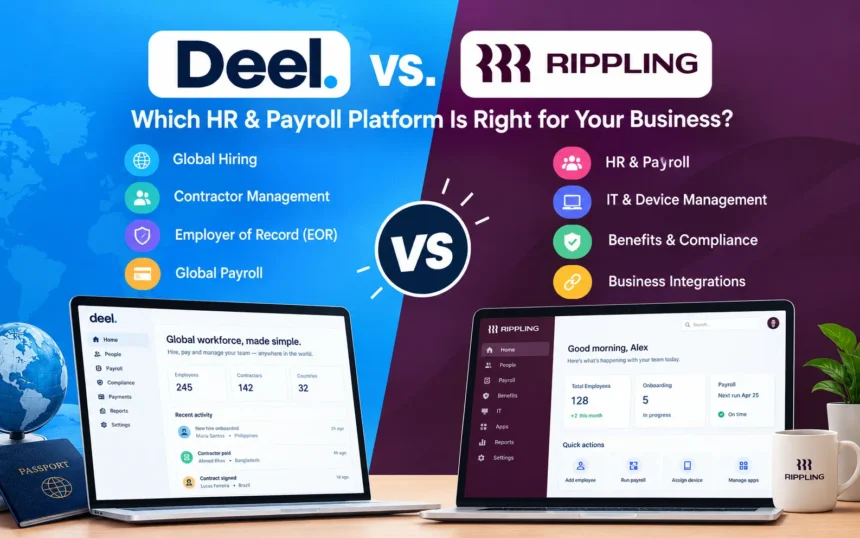
Choosing between Deel and Rippling depends on how your business hires people, manages payroll, and handles everyday operations. Both platforms help businesses manage employees and payroll, but they take different approaches to solving workforce management problems.
- Deel vs. Rippling: Quick comparison
- Deel
- Rippling
- Side-by-side comparison table
- 1. International hiring and contractor management
- 2. Payroll and compliance
- 3. HR management and employee onboarding
- 4. IT management and business integrations
- 5. Deel vs. Rippling pricing
- 6. Ease of use and customer support
- 7. Pros and cons of Deel and Rippling
- Deel
- Rippling
- 8. Which should you choose? Verdict by business type
- Frequently asked questions
- Final verdict
Deel is particularly attractive to companies hiring international employees and contractors across multiple countries. Rippling stands out for businesses that want to connect HR, payroll, employee benefits, and IT management in one system.
If you’re running a startup, managing a remote team, or expanding into international markets, the right choice depends on which problem you need to solve first.
In this comparison, we’ll look at their key features, international hiring capabilities, pricing considerations, integrations, ease of use, and ideal customers to help you decide.
Deel vs. Rippling: Quick comparison

Deel
Best for global hiring
Deel focuses on international payroll, employer-of-record (EOR) services, contractor management, and global workforce compliance.
Ideal for: Distributed international teams

Rippling
Best for connected operations
Rippling combines HR and payroll with employee benefits, app access, device management, and other business operations.
Ideal for: Growing companies consolidating systems
Side-by-side comparison table
| Feature | Deel | Rippling |
|---|---|---|
| Primary strength | Global workforce management | Integrated HR, payroll, and IT |
| International contractors | Strong global focus | Available, with country and product coverage to verify |
| Employer of Record (EOR) | Major offering | Available in supported markets |
| Global payroll | Strong international emphasis | Available for supported countries and setups |
| US payroll | Available | Major offering |
| Employee benefits | Available in supported markets | Strong US-focused benefits and HR workflows |
| IT and device management | Not its central focus | Major differentiator |
| App access and provisioning | Available integrations and workflows | Deeply integrated identity and app management |
| HR administration | Yes | Yes |
| Compliance support | Global hiring and employment compliance | HR and payroll compliance, depending on service |
| Pricing approach | Product- and workforce-dependent | Module- and workforce-dependent |
| Best fit | International hiring and payroll | Consolidated workforce and IT operations |
Note: Specific features, country coverage, integrations, and service availability depend on the plan and jurisdiction. Confirm the exact package with each provider before purchasing.
1. International hiring and contractor management
This is one of the most important differences between Deel and Rippling.
Deel: Designed around global employment
Deel is a strong option for businesses that hire freelancers, contractors, and full-time employees across different countries. Its services include contractor payments, employment contracts, compliance support, and Employer of Record (EOR) arrangements.
An EOR can legally employ a worker on your behalf in a country where your business doesn’t have its own local entity, subject to the provider’s coverage and local requirements.
For example, a US-based SaaS company could use Deel to hire developers in Bangladesh, designers in the Philippines, and sales representatives in Europe without establishing a separate company in every country.
Deel also provides a centralized way to manage international worker payments and employment documentation. Its published pricing lists contractor management from $49 per contractor per month and EOR services from $599 per employee per month.
Rippling: Global hiring within a broader platform
Rippling also supports international workforce management, including global payroll and EOR services. Its appeal is that international workers can be managed alongside the company’s existing HR, payroll, and IT workflows.
Imagine a US startup with 25 domestic employees and five international hires. If the company already uses Rippling to manage employee records, payroll, business applications, and laptops, keeping those workflows connected can be valuable.
However, businesses should verify international country coverage, available employment services, and the full quoted price before choosing Rippling.
Winner for this use case: Deel — particularly for a business whose primary requirement is hiring and paying workers in multiple countries.
2. Payroll and compliance
Both platforms help reduce the administrative burden of payroll, but the right choice depends on where employees are located and which payroll responsibilities the company needs to outsource.
Deel focuses heavily on international payroll and workforce compliance. It offers global payroll for companies with their own legal entities, as well as EOR services for hiring employees without establishing local entities themselves.
Rippling connects payroll with employee records and other workforce processes. This can be particularly useful for US businesses that want changes to employee information, compensation, benefits, and employment status to flow through a connected system.
Neither platform eliminates the employer’s responsibility to choose the correct employment arrangement or verify applicable local rules. Tax treatment, benefits, statutory contributions, and reporting requirements vary by jurisdiction.
Verdict: Deel is the stronger starting point for complex international employment needs. Rippling is compelling for companies that want payroll tightly integrated with domestic HR and IT operations.
3. HR management and employee onboarding
Both platforms offer HR capabilities, including employee records, onboarding workflows, and workforce administration.
Deel’s strength is managing a geographically distributed workforce. Its global employment services can help coordinate contracts, onboarding documentation, payroll, and compliance processes across supported countries.
Rippling’s strength is connecting HR with other systems. A new employee’s onboarding process can be tied to payroll setup, benefits enrollment, business app access, and device provisioning.
For example, when a new marketing employee joins a growing company, an integrated Rippling workflow may help the company coordinate the person’s employment records, payroll details, email account, and access to project management software.
Deel may be the more natural choice when the onboarding process involves international contracts and country-specific employment requirements. Rippling may be preferable when the goal is to automate the entire internal employee lifecycle.
Winner: Rippling for connected HR and IT workflows; Deel for international workforce administration.
4. IT management and business integrations
This category gives Rippling a distinct advantage.
Rippling: Connected IT management

Rippling combines HR data with IT workflows, including application access, identity management, and device administration. Depending on the products purchased, businesses can automate access provisioning when employees join and revoke access when they leave.
Deel: Workforce-first integrations

Deel offers integrations and technology features that support HR, payroll, and workforce management. It also has IT-related offerings with personalised dedicated IT management manager who will help you to setup everything on place so that you don’t have to worry about anything.
Winner: Deel for companies that want HR, payroll, app access, and device management working together. Businesses that only need basic HR and payroll may not benefit enough from those extra capabilities to justify the additional cost.
5. Deel vs. Rippling pricing
Pricing is important because both providers offer multiple products rather than one identical package for every business.
Deel publishes starting prices for several services, while Rippling’s final price depends on the selected products and a custom quote.
| Product | Deel published starting price | Rippling |
|---|---|---|
| Contractor management | $49/contractor/month | Request a quote for applicable products |
| Employer of Record | $599/employee/month | Request a quote |
| Global payroll | From $29/employee/month | Request a quote |
| US PEO | $125/employee/month | Request a quote |
| Core HR / platform | Depends on product | Starts at $8/employee/month plus a monthly base fee |
Prices are in USD and reflect published starting rates available at the time of writing. Products, billing units, eligibility, and additional fees may vary. Verify current terms directly with each provider.
Which platform is more affordable?
There isn’t a universal winner on price.
- Deel is useful when you want to estimate international hiring costs before speaking with sales. Published starting prices make initial budgeting easier.
- Rippling may offer better overall value when you would otherwise pay for several separate HR, payroll, identity, and device management tools. Its total cost depends on the selected modules and base fees.
Avoid comparing a single advertised per-worker rate with the total cost of a different platform. Ask both providers to quote the same headcount, countries, employment types, and required services.
For a small startup hiring just a few international contractors, the best value may be the service that meets the requirements without adding unnecessary modules. For a larger company consolidating multiple systems, integration and administrative savings may matter more than the starting price.
6. Ease of use and customer support
Both platforms are designed to reduce manual work, but the initial setup experience can differ.
Deel’s international hiring workflows are useful for companies onboarding workers across multiple jurisdictions. Having contracts, payments, and employment documentation managed through one platform can simplify otherwise fragmented processes.
Rippling’s appeal comes from connecting employee information to multiple business systems. Once configured, automated workflows can reduce the number of separate administrative tasks that HR and IT teams need to complete.
However, a platform with more capabilities may also require more planning during implementation. Companies adopting multiple Rippling modules should consider setup, permissions, data migration, and ongoing administration. Businesses using Deel for complex international arrangements should similarly confirm country-specific requirements and support coverage.
Before signing a contract, ask both providers about implementation fees, onboarding assistance, support availability in your time zone, and the process for resolving payroll errors.
Verdict: Deel is a sensible starting point for internationally distributed teams. Rippling is attractive for businesses seeking to consolidate and automate a broader range of internal operations.
7. Pros and cons of Deel and Rippling
Deel
| Pros | Cons |
| Strong global hiring focus Contractor and EOR services Published starting prices for key services Centralized international workforce administration Cons EOR can be expensive for each employee Not the obvious first choice for deep IT administration Final costs depend on service and country | EOR can be expensive for each employee Final costs depend on service and country |
Rippling
| Pros | Cons |
| Connected HR, payroll, and IT workflows App access and device management Broad business application integrations Modular platform for growing teams Cons Most product pricing requires a quote Multiple modules can increase total costs International coverage should be checked for each use case | Most product pricing requires a quote Multiple modules can increase total costs International coverage should be checked for each use case |
8. Which should you choose? Verdict by business type
The best choice becomes clearer when you consider your actual workforce and operational needs.
| Your business situation | Recommended platform | Why |
|---|---|---|
| Hiring employees across several countries without local entities | Deel | International EOR is a core offering |
| Paying international freelancers and contractors | Deel | Strong focus on global contractor administration |
| US startup replacing separate HR, payroll, and IT tools | Rippling | Connected workflows can consolidate systems |
| Company managing employee laptops and app permissions | Rippling | Dedicated IT and device management capabilities |
| International company with established local entities | Either | Compare country-specific payroll, integrations, and costs |
| Business wanting visible starting prices before contacting sales | Deel | Publishes starting prices for key services |
My recommendation for a specific use case
Choose Deel if you’re building a remote-first SaaS company and plan to hire developers, marketers, and contractors in Bangladesh, India, the Philippines, and other countries. Its international hiring focus and published pricing make it a practical place to start evaluating your workforce setup.
Choose Rippling if you’re running a US-based company with a growing domestic team and want employee onboarding, US payroll, benefits, app access, and laptop management connected in one system. In that situation, its broader platform can be more valuable than choosing a service primarily around international employment.
If you need both, compare whether one platform can handle your entire workforce effectively or whether a separate global employment solution alongside your existing HR system would be more appropriate.
Frequently asked questions
Is Deel better than Rippling for international hiring?
For companies whose primary need is hiring employees and contractors internationally, Deel is often the better starting point. Rippling also offers global workforce services, so the final decision should depend on the countries involved, employment arrangements, and integration requirements.
Is Rippling cheaper than Deel?
Not necessarily. Rippling publishes a starting platform price but generally requires a custom quote for the complete package. Deel publishes starting prices for several major services. Compare written quotes with identical requirements before deciding.
Can Deel and Rippling pay international contractors?
Both support international workforce payment use cases. The available payment methods, countries, contractor services, and fees differ, so verify the exact arrangement with each provider.
Can a small business use either platform?
Yes. A small business can evaluate either provider, but it should select only the services it needs. A business with three international contractors may have different priorities from a 50-person company managing US payroll, benefits, and employee devices.
Do Deel and Rippling replace an accountant?
No. Both can automate parts of payroll and employment administration, but businesses may still need accountants, tax professionals, or legal advisers for jurisdiction-specific advice and obligations.
Final verdict
Deel and Rippling are both capable workforce management platforms, but they solve different primary problems.
- Best for international hiring and contractor management: Deel.
- Best for integrated HR, payroll, and IT operations: Rippling.
- Best value: Whichever meets your actual requirements at the lower total cost, including implementation, platform fees, and ongoing administration.
Start with the business problem you need to solve, not the number of features on a pricing page. Request a quote from both providers if your needs overlap, and compare the same workforce scenario before committing.
Explore the platforms: Deel official website · Deel pricing · Rippling official website · Rippling pricing