

When I explore AI tools for businesses, I’m particularly interested in solutions that do more than simply organize information. The tools that really catch my attention are those that help business owners understand what might happen next and make better decisions before problems arise.
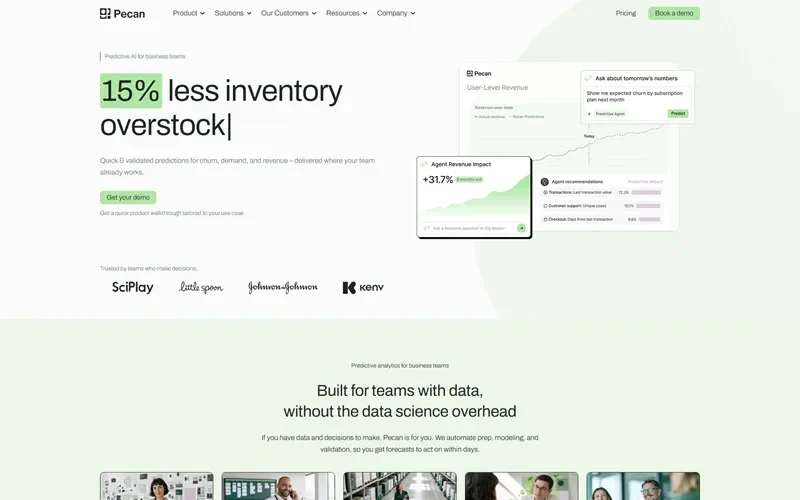
That’s what makes Pecan AI interesting to me. It focuses on predictive analytics, helping businesses use their existing data to forecast customer behavior, identify potential sales opportunities, and make more informed decisions. Instead of relying entirely on historical reports, businesses can use predictions to plan their next steps.
What I Like About Pecan AI
One thing I appreciate about Pecan AI is its focus on making predictive analytics more accessible. Traditionally, building machine learning models often requires specialized technical knowledge, experienced data scientists, and considerable development time.
Pecan AI aims to simplify that process by automating much of the data preparation, model building, and validation work. Its AI agent guides users from a business question to a predictive model, reducing the amount of manual work involved.
Personally, I think this is a valuable approach because collecting data isn’t enough. Businesses need to understand what that data means and how they can use it to improve their results.
For example, an online business might want to identify which customers are likely to make another purchase. A subscription company might want to recognize customers who are at risk of cancelling. Pecan AI is designed to help businesses investigate these kinds of questions using predictive models.
How Pecan AI Can Help Businesses
What I find particularly interesting is the range of business problems Pecan AI can address.
Customer retention is a good example. Losing customers can hurt revenue, especially for subscription-based businesses. Predictive models can help identify customers who may be more likely to leave, giving the business an opportunity to take action earlier.
Marketing is another area where this approach can be useful. Rather than treating every lead or campaign equally, businesses can use predictions to prioritize promising opportunities and make better decisions about where to spend their budgets.
I also like the potential for demand forecasting. Businesses that sell physical products need to estimate future demand so they can manage inventory and avoid unnecessary costs. Predictive analytics can help them plan using historical sales patterns and other relevant information.
For me, the biggest advantage is the shift from simply looking at what has already happened to estimating what could happen next. That can be especially valuable when decisions have a direct impact on revenue, customer retention, or operating costs.
Is Pecan AI Easy to Use?
I think Pecan AI’s emphasis on automation is one of its most appealing qualities. According to its official website, users can ask business questions in natural language while the platform helps prepare data, build models, evaluate predictions, and deliver results.
The platform also connects with existing data sources and business tools, including Snowflake, Google BigQuery, Salesforce, and HubSpot. This can help businesses incorporate predictions into their existing workflows rather than maintaining an entirely separate process.
Of course, automation doesn’t eliminate every challenge. Businesses still need relevant historical data, a clear understanding of the problem they want to solve, and a way to evaluate whether the predictions are useful.
I would also want to test the platform with my own data before relying on its forecasts for important decisions.
The Pros and Cons of Pecan AI
Every business tool has strengths and limitations, and I think it’s important to consider both before making a decision.
Pros
- Predictive insights: Helps businesses forecast customer behavior, demand, revenue-related outcomes, and other important business metrics.
- Less manual work: Automates several stages of predictive modeling, including data preparation and model evaluation.
- Accessible AI: Designed to help business teams work with predictive analytics without requiring extensive machine learning expertise.
- Multiple use cases: Supports applications such as customer churn prediction, lead scoring, customer lifetime value modeling, and demand forecasting.
- Business tool integrations: Connects with various data warehouses, databases, and business applications.
- More proactive decisions: Can help businesses identify potential opportunities and risks before they become obvious in traditional reports.
Cons
- Requires suitable data: Predictions are only as useful as the data and business context behind them.
- Pricing may be a consideration: Businesses should request a quote and evaluate whether the expected value justifies the cost.
- May be excessive for small businesses: Companies with basic reporting needs may not need a dedicated predictive analytics platform.
Who Should Consider Pecan AI?
In my opinion, Pecan AI is particularly worth exploring for businesses that already collect substantial amounts of customer, sales, or operational data but aren’t getting enough value from it.
Marketing teams can use predictive insights to improve campaign decisions. Sales teams can prioritize leads. Customer success teams can identify potential churn risks, while operations teams can make better-informed demand forecasts.
I can also see the appeal for subscription businesses and e-commerce companies, where understanding repeat purchases, customer lifetime value, and future demand can have a meaningful effect on profitability.
However, if you’re running a small business with limited historical data or only need straightforward reports, I would start with simpler analytics tools before investing in a specialized platform.
My Final Thoughts on Pecan AI
Overall, Pecan AI strikes me as an interesting option for businesses that want to make more informed decisions using the data they already have.
What I like most about its approach is the emphasis on making predictive analytics more accessible. Businesses don’t necessarily need to build every machine learning model from scratch to start exploring how predictions could improve their operations.
At the same time, I wouldn’t expect AI predictions to solve every business problem automatically. The real value comes from asking the right questions, using reliable data, and turning the results into practical actions.
My recommendation: If your business wants to move beyond basic reporting and start using predictive analytics to improve marketing, customer retention, or demand planning, Pecan AI deserves a closer look. I’d begin by identifying one specific business problem, exploring the platform’s capabilities, and evaluating its predictions against real business results before expanding further.
Check it out — Try Pecan AI Now